

Trusted sustainability certification for luxury
Built for the future of sustainability legislation. Independently verified. Designed to help consumers choose with confidence and brands to communicate with credibility. The Butterfly Mark is a sustainability certification for luxury brands, awarded only to brands that can prove they meet clear requirements across Environment, Social and Governance (ESG). Explore how the Butterfly Mark Certification works, what brands have to prove and how certification is independently verified. For the full technical detail, you can also access the scheme documentation and audit criteria below.
Overview
Choose proof over promises
Sustainability has become harder to navigate. Consumers want more information but facing a growing number of claims and labels. The Butterfly Mark exists to make things clearer, guiding people to luxury brands that can prove they meet clear sustainability standards. Brands must show evidence of the action they’re taking, against clear requirements across Environment, Social and Governance. That evidence is independently verified before certification is awarded.
Consumers
Empowering consumers
Consumers should be able to understand what a sustainability certification means – and trust that there is evidence behind it. The EU’s Empowering Consumers for the Green Transition (ECGT) Directive strengthens the rules around sustainability labels and vague environmental claims, to give consumers clearer, more reliable information and reduce unsubstantiated green claims. The new Butterfly Mark standard has been designed with these rules in mind, with clear, publicly available requirements, evidence-based assessment and independent third-party verification.
The ESG+2.1 standard
21 Requirements. One clear standard.
The Butterfly Mark assesses the sustainability action that matters for responsible luxury. ESG+2.1 brings this together in 21 clear requirements across Environment, Social and Governance – seven in each area. A brand must meet every requirement that applies to its business. Each requirement sets out the action expected and the evidence needed to prove it, with clear criteria for determining whether it has been met. The requirements cover the major sustainability challenges facing all businesses as well as issues particularly important to luxury – from greenhouse gas emissions, water and human rights to responsible sourcing, materials, circularity and business ethics.
ENVIRONMENT / 07
- 01 Operational carbon emissions
- 02 Energy emissions
- 03 Emissions reduction
- 04 Energy reduction
- 05 Supplier emissions
- 06 Circularity
- 07 Water conservation
SOCIAL / 07
- 01 Safety & wellbeing
- 02 Modern slavery
- 03 Human rights
- 04 Supply chain human rights
- 05 Employee welfare
- 06 Fair pay
- 07 Employee satisfaction
GOVERNANCE / 07
- 01 Company culture
- 02 Ethics & responsible conduct
- 03 Anti-corruption
- 04 Sustainability priorities
- 05 Purpose & action
- 06 Supplier standards
- 07 Responsible procurement
Clear methodology: Each requirement sets out what a brand must demonstrate, the evidence needed and how it will be assessed. You can read the criteria below.
Earning the Mark: becoming a Brand to Trust
Apply
Complete the assessment
Submit evidence
Independent 3rd-party audit
Certification decision
Butterfly Mark awarded
Annual review + 3 year renewal
Verification
Independent verification
Positive Luxury owns, develops and maintains the Butterfly Mark Standard, but does not make the final certification decision. Certification is independently assessed and awarded by an authorised third-party certification body. Control Union is currently authorised by Positive Luxury to independently assess and certify organisations against the Butterfly Mark Standard. The certification body makes the final certification decision independently of Positive Luxury. This separation strengthens credibility and confidence that the requirements have been met.
Stakeholder engagement
Shaped by expertise
The Butterfly Mark was developed with input from Positive Luxury’s Sustainability Council, bringing together academics, sustainability experts, NGOs and luxury industry representatives to provide feedback and expertise as the ESG+ framework evolved. Former Council members included experts and sustainability leaders from organisations such as BSI, UNEP-WCMC, Volans, the University of Cambridge, MIT Sloan, LVMH, L’Oréal and the Centre for Sustainable Fashion. ESG+2.1 builds on this established framework. Future reviews of the standard will include formal independent stakeholder consultation, ensuring the Butterfly Mark continues to evolve with sustainability best practice, regulatory developments and the needs of the luxury industry.
Explore the documents behind the Mark
Explore the documents that define how the certification works, what is assessed and how the Butterfly Mark can be used.
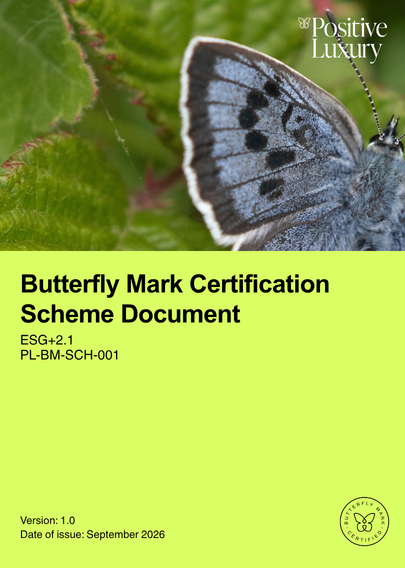
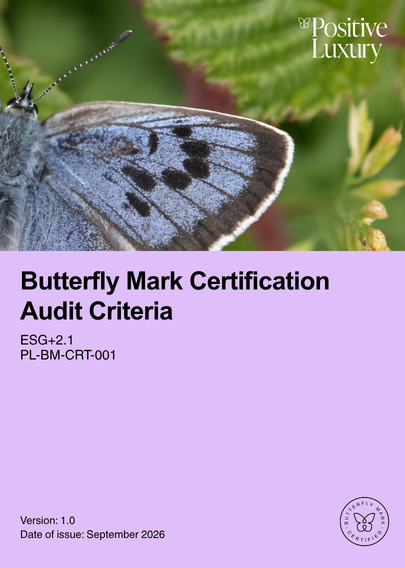
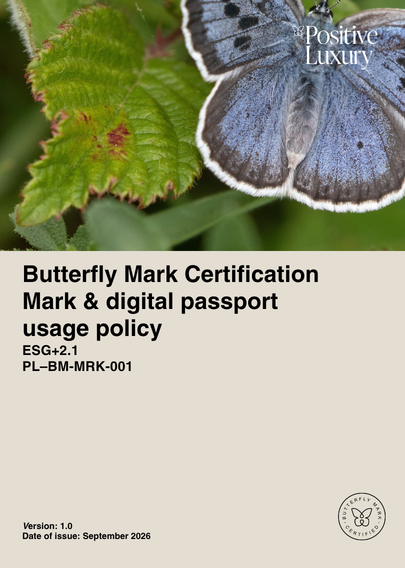
FAQs: Key questions answered
What changed with the ESG+2.1 Butterfly Mark Assessment?
ESG+2.1 replaces the ESG+2.0 assessment and scoring methodology with 21 pass/fail,evidence-based requirements across Environment, Social and Governance pillars. It is designed to further strengthen consistency, transparency and consumer confidence. Under ESG+2.0, evidence was subject to a two-stage verification process by Positive Luxury. Under ESG+2.1, assessment the award of certification is carried out by an authorised independent third-party certification body.
Who independently certifies the Butterfly Mark?
Control Union is currently the authorised certification body for the Butterfly Mark. It independently assesses the evidence submitted by brands against the Butterfly Mark requirements and makes the final certification decision. Positive Luxury owns, develops and maintains the Butterfly Mark Standard, but does not make the final certification decision under ESG+2.1.
Why has Positive Luxury introduced independent third-party certification?
Independent third-party certification creates clear separation between the organisation that owns and develops the Butterfly Mark standard and the organisation that decides whether a brand has met its requirements. Under ESG+2.1, Positive Luxury remains responsible for the Butterfly Mark Standard and provides guidance on the certification requirements, while the final assessment and certification decision are made independently by an authorised certification body.
Are brands certified under ESG+2.0 still Butterfly Mark Certified?
Yes, brands holding a current Butterfly Mark certification under ESG+2.0 remain certified. However, these brands must transition to the new standard through the certification renewal process which includes independent verification against the new requirements. Until then, their Digital Butterfly Passport will make clear that their evidence was assessed and verified by Positive Luxury under the previous assessment, rather than independently certified under ESG+2.1.
What happened to Butterfly Mark percentage scores?
Under ESG+2.0, the Butterfly Mark assessment used a scoring methodology to determine whether a brand had reached the threshold required for certification. ESG+2.1 no longer uses percentage scores to determine or communicate certification. Instead, a brand must meet every requirement that applies to its business and provide the evidence needed to demonstrate that it has done so.
Does every brand have to meet all 21 requirements?
Not every business has to meet all 21 requirements. The number it must meet is determined by the size of the business, using the recognised EU definition of an SME. Larger businesses must meet all 21, while SMEs are assessed against a set of requirements appropriate to their size. Whatever the size of the business, every requirement included in its assessment must be met before Butterfly Mark certification can be awarded.
What evidence does a brand have to provide?
Each Butterfly Mark requirement sets out what a brand must demonstrate and the evidence needed to support it. Evidence varies according to the requirement and can include policies, records, data, contracts and other documentation demonstrating the action being taken. The evidence is independently assessed against the criteria set out in the Butterfly Mark Audit Criteria before certification can be awarded.
Does the Butterfly Mark certify a brand or its products?
The Butterfly Mark certifies the organisation or brand within the defined scope of its certification. It is not a certification of an individual product. When the Butterfly Mark appears on a product or its packaging, it communicates the certification of the brand or business behind it. Consumers can follow the accompanying link or Digital Butterfly Passport to find out more about the certification.
How long does Butterfly Mark certification last?
Butterfly Mark certification operates on a three-year cycle. During the first two years, certification is subject to annual surveillance, including an annual declaration from the certified organisation confirming whether there have been any material changes affecting its certification. Where there has been a material change, an unresolved issue or a credible concern, further surveillance may be required. At the end of the three-year cycle, the organisation must complete full recertification against the requirements in force at that time.
Can smaller businesses apply for the Butterfly Mark?
Yes. The Butterfly Mark can be achieved by luxury businesses of different sizes, and the requirements that apply will depend on the nature and activities of the business. Positive Luxury also offers an Accelerator Programme providing smaller and emerging luxury businesses with a structured route towards Butterfly Mark certification.
How can I find out exactly what brands are assessed against?
Transparency is an important part of the Butterfly Mark. The ESG+2.1 Audit Criteria are publicly available and set out the requirements, what brands must demonstrate and the evidence used to assess whether each requirement has been met.
You can also access the Butterfly Mark Scheme Document, which explains how the certification scheme operates, and the Mark Usage Policy, which sets out how the Butterfly Mark and Digital Butterfly Passport can be used.
Something not right? Tell us.
The Butterfly Mark must be earned and maintained. If you have a concern about how the Mark is being used, or about a Butterfly Mark certification, email us at complaints@positiveluxury.com. Brands and applicants can also appeal a certification decision. Every complaint and appeal is reviewed fairly and impartially, in line with our published Complaints and Appeals Procedure.

Join the Brands to Trust.
Talk to the Positive Luxury team about the benefits of Butterfly Mark Certification for your business.
TALK TO US NOW